Viviane Saint-Lys
The Calamitous BobViviane Saint-Lys is the central displaced protagonist of the narrative, introduced as a twenty-four-year-old corporal and medic serving with a French special-forces platoon at Mopti Airport in Mali. Her decisive transformation begins when that military identity is violently severed from its original setting: instead of waking in the fortified airport, she finds herself in an immense, frozen ruin on Niyl, confronting the remains of a civilization destroyed by its own magical power. From that point onward, her story is both a survival passage through the Deadlands and an involuntary ascent into an imperial identity she neither seeks nor initially understands.
Identity and Displacement
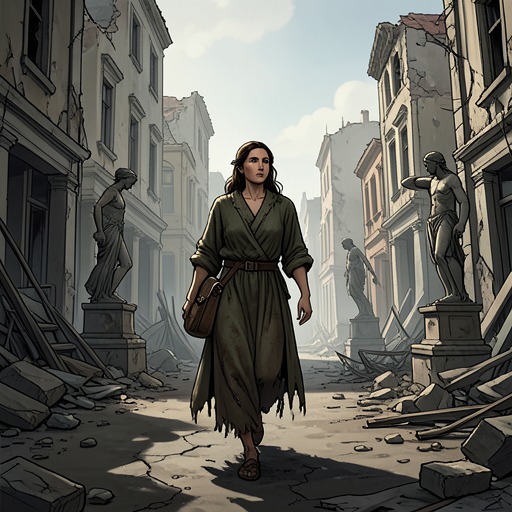
Viviane’s background is defined by concrete professional experience rather than fantasy or royal privilege. She is stationed at Mopti Airport to protect it from jihadists, wearing the beige uniform of the French special forces and carrying a rifle. The opening image of her asleep against sandbags, still clutching that weapon, establishes a soldier trained to remain ready even in exhaustion. Her first response to displacement is correspondingly practical: she pinches herself, notices the cold, assesses whether she has been captured, and rejects that explanation because the airport’s sentries would have detected any disturbance.
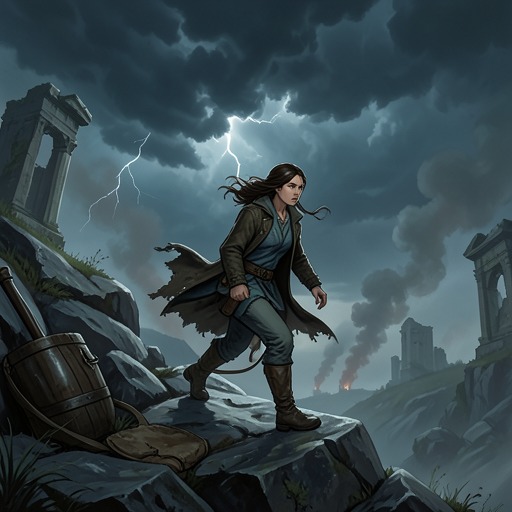
The new environment offers no gradual transition. Viviane stands near the summit of a pyramid of impossible scale, overlooking a rigorously planned dead city of estates, temples, churches, and squares extending for kilometers. Beyond it lie basaltic sands and distant mountains, while rubble as large as apartment buildings is scattered across the landscape. When she turns, she sees that the pyramid’s summit has been blasted from within, leaving a crater with vitrified, molten edges that resembles an asteroid impact or a tactical nuclear strike. The image gives physical form to the catastrophe that has swallowed the Old Empire: the civilization’s greatest monument is also evidence of its self-destruction.
Survival in the Deadlands
Viviane quickly recognizes that remaining in the ruins means death. The threat is not limited to the mindless undead that traverse the sandy corpse of the Old Empire; food and water are absent, and the surrounding environment cannot replenish either. Her deductions are characteristically material and analytical. Campers have chosen exposed camps despite the abundance of buildings, suggesting that the region never receives rain. The area is so barren that she cannot recall seeing even a dried patch of grass, eliminating the possibility of a renewable food source.
This assessment turns escape into her first sustained objective. The ruined heartland is not merely an abandoned city but the western scar of Param, a continent whose greatest magical catastrophe has left a massive valley ringed by snow-capped mountains. The region grows less saturated with black mana toward its southern gap, and Viviane eventually reaches a plateau from which she can see flat plains, mountain openings, and hints of salvation. Beyond the gap, the forest is dense, green, and unmistakably alive. The contrast matters: her passage is measured not only by distance but by the gradual return of ecological possibility.
Yet the border of the Deadlands is defended by zombies and other undead. The plains are dotted with dark shrubbery as the black mana begins to fade, but they are also dotted with the dead. Later, Cernit explains that the Deadlands have reached an equilibrium: the mass of undead monsters generates a black field of its own, and only several large-scale expeditions could reduce it meaningfully. No kingdom is willing to spend that level of resources on land that would take decades to recover when easier territory remains available. Viviane understands the logic even while regretting the abandonment. Kingdoms, as she sees it, are permanently operating in survival mode.
Imposed Heirship and Magical Development
Viviane’s encounter with the Interface radically expands the stakes of her survival. It announces that she is consistent with the stated place of origin and current mana distribution, confirms a consensus condition, and then redesignates her as heir to the throne. The accompanying rule states that only members of the imperial family may give birth in the Imperial Palace, turning her location and apparent origin into the basis for an identity she cannot plausibly reconcile with her memory of Earth. Her shocked response underlines the absurdity of the designation: a French corporal is suddenly treated as a dynastic claimant in the ruins of the Old Empire.
The new identity does not erase her practical instincts. Viviane approaches available paths as a set of tools for survival, comparing lightly armed combat and desk-oriented options while noting that the absence of herbs makes Alchemist a poor choice. She chooses the Black Hedge Witch path, jokingly asking when she will receive a cat and a hat. The choice is initially comic, but its mechanical consequences are substantial: black-aligned spells become more efficient, and relevant skill acquisition improves. Her progression therefore grows from an improvised decision rather than a long-held magical vocation.
That progression later hardens into the Black Witch path. With it, her mental statistics become three times more efficient when wielding black mana, while other types provide only half the normal efficiency, and she loses the ability to manipulate life mana. The power is not abstract. When the mana returns, it causes pain and produces black flames through the conduits saturated in her skin; Viviane ignores the Interface’s warning about mild mana poisoning because the sensation itself has become something she can directly perceive. The black mana aligns especially strongly with her resentment, giving emotional force a functional relation to spell specialization. Her development thus fuses training, bodily danger, and anger rather than presenting magic as a clean or consequence-free gift.
Movement Through Param and Its Peoples
As Viviane moves beyond the Deadlands, she becomes a translator of worlds as much as a traveler through them. With Solfis acting as interpreter, she spends twenty minutes communicating with Baranese knights and learns that she is at the western end of Param, a vast island or continent connected at its eastern side to another major landmass by a narrow isthmus. Cernit’s tattered map places the Harrakan heartlands far from Baran, with several countries, two large neighboring powers, and numerous smaller political units between them. Baran is identified as the largest of these states.
This geography makes Viviane’s imperial designation politically dangerous. Solfis can provoke the knights by discussing conquest, forcing Viviane to tell him to stop. Her foreignness is therefore not a neutral curiosity: she must manage what information can safely be disclosed while learning how the region’s states relate to one another. When Cernit reports that a necromancer has destroyed the two nearest forts, Viviane immediately tests the meaning of the word against the familiar imagery of skulls, bones, and control over the dead. The revelation confirms that the catastrophe surrounding her is not merely historical; necromantic destruction remains an active threat across the living world.
On the road to Kazar, Viviane learns that Kazar belongs to Enoria, a kingdom that fractured fifteen years earlier after its king attempted to purge the nobility following a failed coup. The king replaced a third of the nobles with sycophants, one of his strongest supporters rebelled, and the resulting civil war lasted two years before the king’s death allowed his son to succeed him and both sides to withdraw. The history gives political depth to the world Viviane is entering: the lands beyond the Deadlands are not a stable refuge but a collection of kingdoms shaped by coups, civil wars, and unfinished wounds.
Her encounter with Marruk adds an ethnic and military dimension to that political landscape. Marruk is a female Kark who has recently left her tribe, or what remains of it, while the Kark endure severe hardships. The conflict is not simply a war between humanity and the Kark; many northern free cities have formed an alliance of interest called the Pure League. Viviane is told that Marruk has suffered abuse from local mercenaries despite being reliable in fulfilling promises, a characteristic associated with the Kark. This information helps Viviane evaluate Marruk not through the prejudice directed at non-humans but through conduct, loyalty, and the possibility of a protective relationship.
Companionship, Green Life, and Narrative Role
Viviane’s passage is repeatedly mediated by relationships that keep her from becoming only a solitary survivor. The spring associated with Cassia the Unbroken offers a spiritual counterpoint to Solfis. Cassia had fought for the Empire and the other nations of the continent, was universally loved, and, after dying at the end of a long and fulfilling life, became the source of a spring whose waters still carry Neriad’s blessing. In Cassia’s remains, Viviane perceives serenity, majesty, fulfilled purpose, and deserved rest; meditation comes easily, and she feels welcomed and protected. The experience establishes that Solfis is not the only entity capable of caring for her.
Her relationship with the living world becomes equally important near Kazar. After twenty minutes of travel, she and Arthur reach free land at the edge of the forest. Arthur leaps about, testing the grass with her paws or perhaps her hands, while Viviane smells loam and sap for the first time in an immeasurably long period. The trees are not overtly magical, resembling temperate deciduous trees except for unusual leaf patterns. Arthur climbs from trunk to trunk like an oversized gliding squirrel, while Viviane sits on a stump in tall grass and lets the scene happen.
The image gathers several strands of Viviane’s trajectory into one threshold moment. Kazar stands in the distance, with green hills turning gray toward the top, while the sky beyond remains dark and menacing. Free land is therefore not a complete return to safety; it is a fragile margin between renewal and the still-threatening Deadlands. Viviane’s significance lies in inhabiting that margin. She carries the training and skepticism of a modern soldier, the imposed title of a lost empire’s heir, and the dangerous affinity of a Black Witch, yet her immediate acts remain grounded in assessment, negotiation, protection, and the search for a livable future. Her journey transforms displacement into agency without ever allowing the original rupture to disappear.